

Candidate conversion rate is the percentage of candidates who move from one stage of your hiring funnel to the next, and it is the clearest way to measure whether your recruitment process is actually working.
You can be posting roles, getting applicants, even making hires, and still have no real idea if your recruitment process is actually working well or just working. That is the gap most in-house teams operate in. You know the outcome. You filled the role, or you didn’t. But you don’t know how efficiently you got there, where you lost strong candidates, or what needs fixing.
That is exactly what candidate conversion rate answers. When I look at candidate conversion rate, I am not treating it as a reporting metric. I am treating it as a diagnostic tool within the broader recruitment funnel. It shows me how candidates move through each stage of the hiring funnel and where things are breaking down.
Without it, you are guessing. With it, you can see exactly what is happening inside your talent acquisition process and what to improve next.
Key Takeaways
- Candidate conversion rate measures how efficiently candidates move through your hiring funnel
- Understand where your recruitment process is breaking down by analysing your candidate conversion rate
- Application volume alone does not indicate hiring success because it does not show what happens after candidates enter the funnel
- Each stage of the process tells a different story about hiring performance
- Even small improvements in conversion rates can have a significant impact on hiring outcomes.
What is Candidate Conversion Rate?
Candidate conversion rate is the percentage of candidates who progress from one stage of the recruitment funnel to the next. It measures how efficiently your process moves candidates forward, not just how many you have sitting at each stage.
If I am looking at my recruitment funnel properly, I should have conversion metrics across every transition point, from job ad view to application, application to screening, screening to interview, and all the way through to hire. What makes candidate conversion rate valuable is that it shows movement. It tells me how well each part of the process is doing its job, rather than just showing static numbers.
Why Conversion Rate Matters More Than Application Volume
Application volume is often treated as the goal, but it is only ever an output, not the outcome that actually matters. The outcome is a successful hire. I can have hundreds of applications and still fail to hire the right person. In that case, the conversion rate to hire is effectively zero, regardless of how strong the top of the funnel looks.
What the candidate conversion rate gives me is the full story of my recruitment process. If I want to diagnose a problem or improve hiring funnel efficiency, application volume tells me almost nothing. Conversion rate, on the other hand, shows me exactly where candidate drop-off is happening and why.
I have seen this play out clearly in high-volume recruitment. For example, a client of ours was hiring multiple baristas. Whilst looking at historical recruitment funnel metrics, it allowed them to work backwards from the hiring target. If four hires came from one hundred applications, then hitting ten hires means planning for around four hundred applications. That is not guesswork. That is using conversion data to build a predictable hiring plan.
This is where conversion rate shifts from a reporting number to a decision-making tool, and it naturally leads into how you calculate and track it properly.
How to Calculate Your Candidate Conversion Rate
The Basic Formula
Candidate conversion rate is calculated as candidates who progressed divided by candidates who entered that stage, multiplied by one hundred. It is a simple formula, but it becomes powerful when applied consistently across every stage of your recruitment funnel.
How to Calculate the Conversion Rate at Each Funnel Stage
Each stage in the funnel has its own conversion rate, and together they form your candidate pipeline conversion rate. Job posting conversion rate is calculated by dividing applications received by job ad views. Candidate to screening conversion rate is the number of screened candidates divided by the total applications. Screening to interview conversion rate is the number of interviewed candidates divided by the number of screened candidates. An interview to offer conversion rate is offers made divided by candidates interviewed. Candidate to hire conversion rate is offers accepted divided by offers made.
Each of these numbers represents a different part of your process, and each one highlights a different potential issue or opportunity for improvement across your talent acquisition process.
A Worked Example for an In-House HR Team
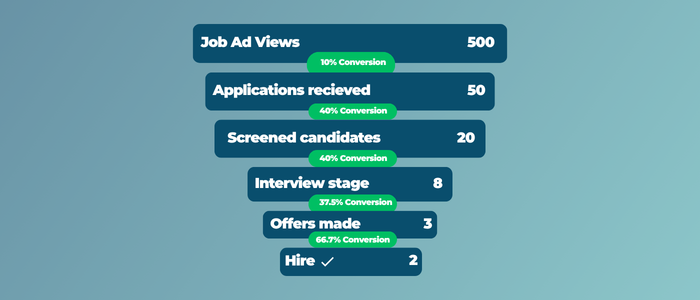
To make this practical, consider a mid-sized business hiring for a role. If five hundred people view your job ad and fifty apply, that gives you a ten per cent job posting conversion rate. From those fifty applications, if twenty are screened, that is a forty percent candidate to screening conversion rate. If twenty screened candidates become eight interviews, that is another forty per cent conversion. From those eight interviews, if three offers are made, that results in a thirty-seven point five percent interview to offer conversion rate. Finally, if two of those offers are accepted, that gives you a sixty-six point seven percent candidate to hire conversion rate.
Looking at this as a whole, I am not just seeing isolated numbers. I am seeing how the funnel behaves, where it is performing well, and where there may be inefficiencies or candidate drop-off points that need attention.
Recruitment Conversion Rate Benchmarks: What Good Looks Like
For mid-market businesses, you can use the metrics below as conversion rate benchmarks.
| Views → Applications | 5–15% |
| Applications → Screened | 15–30% |
| Screened → Interview | 30–60% |
| Interview → Offer | 20–40% |
| Offer → Hire | 70–90% |
Your own historical data is the best indication of whether your conversion rates are improving or not. The earlier you start measuring, the quicker you can begin to identify recruitment funnel gaps and optimise from there.
How to Read Your Conversion Data: What Each Stage Is Telling You
Low Job Posting Conversion Rate: A Job Ad Problem
If I am seeing a high number of views but a low number of applications, something in my job ad or application step is preventing candidates from moving forward. That could be the application form itself, the screening questions, or the overall offer in the market, including salary, benefits, and positioning.
If I am seeing low views as well as low applications, that points to a different issue. That is an awareness problem. It means I am not reaching the market effectively, whether that is due to poor distribution, the wrong job boards, or even using job titles that candidates are not actually searching for. Something as simple as using an internal title instead of a commonly searched one can significantly reduce visibility.
Low Application Completion Rate: A Friction Problem
If candidates are starting the application but not finishing it, that is almost always a candidate experience issue. I look at whether I am asking for too many documents, whether the process is mobile-friendly, and whether candidates are being required to complete long-form answers unnecessarily.
For example, if someone is applying on their phone and is asked to upload multiple documents they do not have readily available, they are likely to drop off and move on to another opportunity. In many cases, simplifying the process and reducing friction has a direct and measurable impact on completion rates and overall recruitment conversion rate.
Low Screening Conversion Rate: A Selection Criteria Problem
If I am seeing low conversion from application to screening, it tells me there is a misalignment between who is applying and what I am actually filtering for.
I have seen this where application volume is strong, but very few candidates make it through. The assumption is that candidate quality is low, but more often the criteria do not reflect the reality of the market.
For example, attracting entry-level candidates while screening for experienced hires, or widening reach but keeping narrow location or experience requirements.
The opposite can also happen. If criteria are too broad, too many candidates pass through, and the problem shifts downstream into interview.
The adjustment is to bring alignment between attraction and screening. When what I am targeting, attracting and filtering for are consistent, candidate flow through this stage becomes far more predictable.
Low Interview-to-Offer Rate: An Assessment Problem
If candidates are reaching the interview but not progressing to an offer, I focus on what is happening between those stages. One of the biggest factors here is speed. There is often a lot happening after an interview, including reference checks, approvals, and additional steps, and if that process is slow or overly complex, strong candidates will move elsewhere.
In competitive markets, delays can cost you hires. Improving this stage often comes down to reducing unnecessary steps, automating processes where possible, and maintaining consistent communication with candidates so they remain engaged throughout the hiring funnel.
How to Improve Your Candidate Conversion Rate at Each Stage
I think about improvement in two parts. The first is everything that happens before the application, where candidate attraction should be treated like a marketing exercise. That includes the job ad, the channels you use, and the messaging, all of which need to be designed to attract and convert the right candidates.
The second part is everything that happens after the application. This is where speed becomes critical. Once a candidate enters your applicant tracking system or recruitment software, your workflow needs to move them through quickly and consistently. Delays at this stage are one of the biggest causes of candidate drop-off.
Communication is equally important. Candidates need to know where they are in the process at all times. If they do not, they disengage. The biggest improvements I typically see come from optimising the early post-application stages, particularly moving candidates quickly from application to screening and from screening to interview, which improves candidate experience and overall conversion.
How to Track Candidate Conversion Rate Without a Data Team
For most in-house teams, tracking candidate conversion rate can feel complex, but it does not need to be. The simplest way to start is to focus on one role. By looking at how that role performs across key stages such as views, applications, and progression, I can immediately gain visibility into what is happening.
From there, it becomes easier to expand across more roles as capability grows. The key shift is in perspective. When I start viewing recruitment as a funnel with measurable stages, I naturally begin to identify where improvements can be made.
Working with the right recruitment partner or using recruitment software that provides visibility across those stages makes this process scalable and much easier to manage without needing a dedicated data team.
Summary and Next Steps
If there is one thing I would change about how most teams approach recruitment, it is this. Stop looking only at outcomes and start looking at the process.
When I understand my candidate conversion rate, I can clearly see where my recruitment funnel is working and where it is not. The first step is simple. Start small, focus on one role, and track how candidates move through each stage.
That shift in perspective changes how you approach hiring and gives you a clear path to improving it.
Frequently Asked Questions (FAQ)
About the author
 |
Helen Dwyer General Manager of Product, Technology & NetEngine, Scout Talent Group With a decade of experience in talent acquisition software and services, I’ve been part of the journey to grow Scout Talent Group. My focus is on fostering collaboration, championing innovation, supporting strategic growth, and creating the conditions for long-term success. I enjoy the challenge of connecting people, ideas, and technology to unlock potential and drive meaningful outcomes. |