

Most organisations think about recruitment as filling a single role. There is an empty seat, a job gets approved, and the focus becomes getting someone into that position as quickly as possible.
When I shifted to thinking about recruitment as a funnel, everything changed. I stopped solving for one hire and started building a system for attracting, converting and hiring the right talent – consistently, at scale.
That shift brings structure, visibility and measurability to a process that, in most organisations, has none.
Key Takeaways
- A recruitment funnel turns hiring from a reactive task into a measurable system
- Most hiring problems are funnel problems, not candidate problems
- Each stage can be diagnosed and improved using data
- Your own historical trend data is more valuable than any industry benchmark
- The right recruitment software enables consistency, speed and better decisions
What Is a Recruitment Funnel?
A recruitment funnel is a structured model that maps the full candidate journey, from first awareness through to onboarding. The stages typically include awareness, attraction, application, screening, interview, offer, hire and onboarding.
What matters isn’t just naming the stages. It’s understanding how they connect.
When I use a recruitment funnel, I’m treating hiring as a predictable system. I can track candidate movement at every stage, identify where drop-offs occur, and make targeted improvements – without guessing.
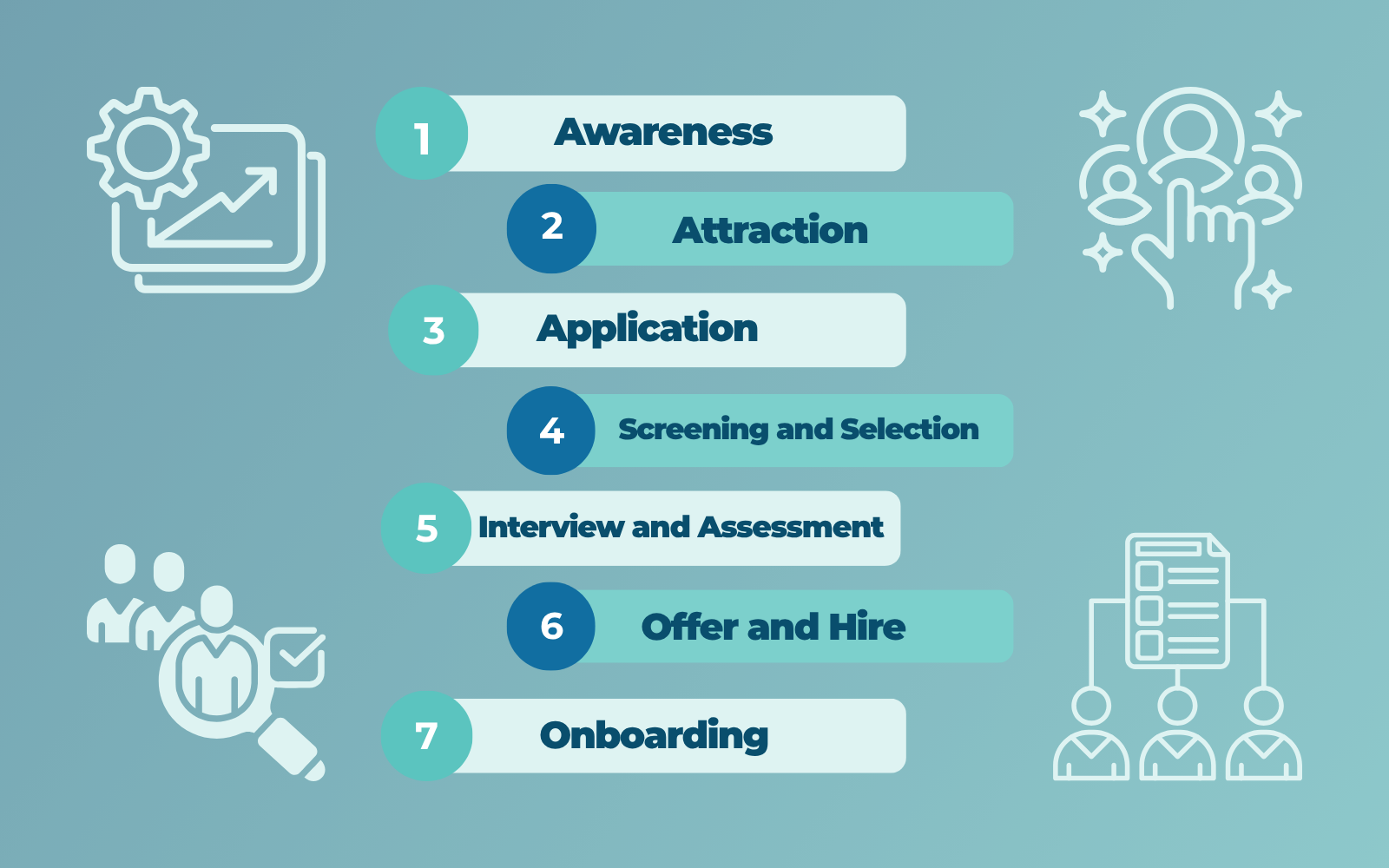
The Stages of a Recruitment Funnel
Stage 1: Awareness – Getting in Front of the Right Candidates
Awareness is about getting your role in front of the right candidates. If I am not reaching the market, the rest of the funnel does not matter.
This is where recruitment marketing – and tools built to support it – become essential for building a consistent talent pipeline, not just filling individual roles.
Stage 2: Attraction – Your Job Ad as the Conversion Point
Attraction determines whether candidates engage with your role. If I am getting high application volume but low-quality candidates, the issue is usually messaging.
A strong job ad must clearly define who the role is for and who it is not for. Without that clarity, unsuitable candidates enter the funnel and create inefficiencies downstream.
Key focus at this stage:
- Clear role positioning
- Defined ideal candidate
- Strong filtering through messaging
Stage 3: Application – Removing Friction from the Process
The application stage is one of the biggest conversion points in the candidate recruitment funnel.
Friction at this stage kills conversion. I see this in organisations using outdated systems or poorly configured processes, where applying becomes harder than it needs to be.
Common friction points include:
- Long or unnecessarily complex application forms
- Requiring account creation before applying
- Poor mobile experience
- Asking for information that isn’t needed at this stage
Modern applicant tracking systems (ATS) eliminate most of this. The organisations that haven’t addressed it are losing candidates they never knew they had.
Stage 4: Screening and Selection – Calibrate for the Market
This stage determines how effectively I filter candidates.
If I’m overwhelmed with unsuitable candidates, my criteria are too broad. If I’m struggling to get candidates through at all, they’re too rigid – particularly damaging in tight talent markets where strong candidates have options.
In high-volume roles, structured screening questions aligned to real hiring criteria (location, availability, specific skills) can reduce noise significantly. In constrained markets, overly strict screening becomes a barrier, and quality candidates exit early.
I’ve seen both extremes. The answer is always: calibrate to the market you’re actually in.
Stage 5: Interview and Assessment – Speed Is a Strategy
This is where evaluation deepens – and where slow, inconsistent processes cost organisations the most.
The biggest drop-off point in most recruitment funnels isn’t the application. It’s what happens after. If the process is slow, communication is poor, or the next steps are unclear, candidates disengage. In competitive markets, they accept other offers.
In most cases, this isn’t a strategy problem. It’s a systems problem. Recruiters are overwhelmed, moving between spreadsheets and inboxes, and lack the tools to move quickly and consistently.
Stage 6: Offer and Hire – A Signal, Not the Destination
By the time a candidate reaches the offer stage, they should already have a clear understanding of the role, the opportunity, and what to expect. When they disengage at that point, it often means there has been a disconnect somewhere along the way. That disconnect may come from how the role was positioned at the start, whether expectations around salary, flexibility, progression, or responsibilities were properly aligned, or whether the interview process built enough trust and momentum.
Stage 7: Onboarding – The Stage Most Organisations Forget
Onboarding is part of the recruitment funnel, not separate from it.
The candidate experience does not end at acceptance. How I bring someone into the business directly impacts retention and long-term success. A strong offer undermined by a poor onboarding experience is a recruitment failure.
Using onboarding software like Scout Talent’s :Onboard helps create a consistent experience.
Is There a Difference Between a Recruitment Funnel vs. a Recruitment Marketing Funnel?
I do not treat these as separate funnels.
Recruitment marketing is the strategy that drives the awareness and attraction stages. It’s not a parallel process. It’s part of the same system, and it should be measured the same way.
Common Pitfalls at Each Stage of the Hiring Funnel
Pitfall: Job Ads That Attract Volume but Not Quality
If I am seeing high application volume but poor candidate quality, the issue is usually at the attraction stage.
I worked with a client hiring into pathology roles where no prior experience was required. The job ads were intentionally broad to drive volume – and they delivered. The applications came in.
But the funnel broke immediately after. There was no natural filtering, and the team became overwhelmed trying to process unsuitable candidates.
The fix came in two parts:
- Refining the messaging to better define the ideal candidate
- Introducing structured screening questions based on actual hiring criteria
For example, proximity to the work location became a key filter. That single adjustment reduced noise and improved candidate quality without reducing volume.
Pitfall: Selection Criteria That Are Too Broad or Too Rigid
If I have too many candidates, my criteria are too loose. If I have too few, they are too strict.
I always tie this back to the talent market. In high-supply markets, I can afford stricter filtering. In low-supply markets, I need to reduce friction and widen access.
Geography also plays a role, with rural markets behaving very differently from urban ones.
Pitfall: A Slow or Friction-Heavy Application Process
A friction-heavy process creates a drop-off before I even get a chance to assess candidates.
I see this in organisations that require logins, use long or outdated forms, lack mobile optimisation, or do not support integrations like LinkedIn apply.
But friction doesn’t end at submission. If recruiters can’t respond quickly because they’re overwhelmed or relying on manual processes, strong candidates disengage. At that point, it’s both a funnel problem and a systems problem – and the organisation usually only notices the symptom: fewer good candidates.
Pitfall: No Visibility Over Where Candidates Are Dropping Off
This is the most damaging pitfall because it leads to misdiagnosis, and misdiagnosis leads to solving the wrong problem.
I’ve seen organisations genuinely believe they have a talent shortage. When the data became available, the reality was different. Some had high traffic to job pages but almost no applications.
That distinction matters:
- High views with low applications means the offer or messaging is not resonating
- Low views with low applications means the role is not reaching the market
Without visibility, both scenarios look identical. With data, they require entirely different responses. The organisations investing in recruitment software gain this visibility as a default. Those relying on spreadsheets are flying blind.
Recruitment Funnel Metrics: What to Measure and Why
Conversion Rate by Stage
Each step highlights where the funnel is working and where it is breaking. Over time, my own historical data becomes the most valuable benchmark.
Conversion rate shows how candidates move through the funnel. At the highest level, I can track application to hire – but the real insight comes from breaking it into smaller steps:
- Views → Applications
- Applications → Screened
- Screened → Interview
- Interview → Offer
- Offer → Hire
Each step exposes where the funnel is working and where it’s breaking. Tracked consistently over time, this data becomes the most reliable guide for optimisation.
Indicative Benchmarks (Mid-Market):
| Stage | Conversion Range |
| Views → Applications | 5–15% |
| Applications → Screened | 15–30% |
| Screened → Interview | 30–60% |
| Interview → Offer | 20–40% |
| Offer → Hire | 70–90% |
A benchmark tells you how others are performing. Your own historical trend tells you whether you’re improving. For most organisations, the trend is more actionable.
Time to Hire and Time to Fill
Time to hire and time to fill are often used interchangeably, but they measure two very different parts of the recruitment funnel.
Time to hire measures speed once a candidate is in your funnel. It is the time between when a candidate enters the process, usually from application or sourcing, through to when they accept an offer.
Time to fill measures the entire process. It starts from when the role is opened or approved and ends when the candidate accepts the offer.
The difference matters because they diagnose different problems.
For in-house teams, time to hire is typically the more actionable metric because it sits within direct control and can be optimised without structural change.
Cost per Hire
Cost per hire tells me how efficient the recruitment funnel is – not just how much a hire costs.
Cost per hire = total recruitment costs ÷ number of hires
This includes advertising spend, agency fees, employer branding, and internal costs like recruiter time and software. Tracked over time, it reflects whether process improvements are translating into real efficiency gains.
Application Completion Rate
Application completion rate tells me how many candidates start an application versus how many actually finish it.
It is calculated by taking the number of completed applications and dividing it by the number of candidates who began the process.
Application completion rate = completed applications ÷ started applications
Although it is a simple metric, it is incredibly powerful because it isolates friction at the exact point where candidates are converting.
How Recruitment Software Gives You Visibility Over Your Entire Funnel
Full visibility starts with understanding the recruitment workflow I’m actually running and implementing software built to track and support it.
Without the right system, I’m relying on manual tracking and gut feeling. With it, I get:
- Real-time visibility across every stage of the funnel
- Automated tracking of candidate movement
- Faster identification of drop-off points
- Consistent, repeatable workflows at scale
- Access to historical data and trends that sharpen future decisions
This is what enables the shift from reactive hiring to data-driven optimisation.
Summary and Next Steps
If there’s one thing I want HR leaders to take from this, it’s straightforward: treat candidates like customers.
The same rigour applied to sales pipelines and marketing funnels should exist in the hiring process. Because candidates aren’t just applicants. They’re future employees, brand advocates, and a direct reflection of how the business operates.
When recruitment is built and optimised with that mindset, the entire system improves.
Frequently Asked Questions (FAQ)
About the author
 |
Helen Dwyer General Manager of Product, Technology & NetEngine, Scout Talent Group With a decade of experience in talent acquisition software and services, I’ve been part of the journey to grow Scout Talent Group. My focus is on fostering collaboration, championing innovation, supporting strategic growth, and creating the conditions for long-term success. I enjoy the challenge of connecting people, ideas, and technology to unlock potential and drive meaningful outcomes. |