

Recruitment in Australia is shifting again.
While hiring volumes continue to fluctuate in response to economic conditions, one reality remains constant: competition for scarce skills is intense, and expectations on HR and talent teams continue to rise.
Looking ahead to 2026, the focus for Australian organisations will not simply be on hiring more people. It will be on hiring with greater speed and discipline, delivering a candidate experience that supports your inclusivity, and using recruitment technology in practical, governed ways that support better decisions.
These seven recruitment trends highlight what’s changing, and what HR and talent leaders should prioritise next.
Hiring remains highly competitive, with skills shortages evident across key sectors
Although overall labour market pressure eased slightly through 2025, hiring conditions in Australia remain highly competitive, with persistent skills shortages continuing to affect key sectors. This reflects broader workforce outlook findings, including those outlined in Talent International’s Australia’s Hiring Market: Workforce Outlook for 2026, which highlight ongoing challenges across healthcare, education, construction, and a range of specialist and technical roles. These shortages are structural in nature and are not being resolved by short-term shifts in employment levels.
In healthcare and education, demand continues to be driven by population growth, ageing demographics, and ongoing service delivery pressures. Construction roles also remain in short supply due to long project pipelines, infrastructure investment, and sustained housing demand. At the same time, specialist roles across technology, engineering, and professional services are proving difficult to fill, particularly where experience and regulatory or technical expertise are required.
Cost-of-living pressures are also reshaping workforce participation. As household expenses increase, more parents and secondary income earners are returning to work earlier or taking on additional hours. While this has increased movement within the labour market and expanded candidate pools in some areas, it has not significantly eased competition for highly skilled or in-demand roles. Instead, it appears it has contributed to higher levels of churn without meaningfully increasing supply where shortages are most acute.
This combination of ongoing skills gaps and economic pressure is expected to keep hiring conditions tight for the foreseeable future. Industry reporting suggests demand for skilled workers remains strong in states such as Western Australia, Queensland and South Australia, particularly across trade and construction-related roles. This is likely to keep competition for talent elevated through 2026, even as broader labour market conditions soften.
Pay is a key driver of role acceptance in the Australian market
For many Australian employees, the decision to change roles is now driven primarily by take-home pay, rather than job title, seniority, or perceived status. Candidates are increasingly pragmatic in their approach to career moves, prioritising employers that can deliver tangible financial improvement over those offering progression in name only. As a result, it is becoming more common for candidates to trade prestigious titles or linear career steps for roles that provide clearer and more immediate salary gains.
This shift reflects broader economic pressures facing Australian workers. Rising living costs, persistent inflation, and higher interest rates have sharpened focus on household budgets, making remuneration a more decisive factor in employment decisions. These dynamics align with wider workforce outlook findings, including those outlined in Talent International’s Australia’s Hiring Market: Workforce Outlook for 2026, which indicate that compensation has become a more dominant factor relative to many traditional motivators in role selection.
While this trend has been building for several years, it is expected to accelerate through 2026 as cost-of-living pressures continue to influence workforce behaviour. Candidates are entering hiring processes better informed, more confident in discussing salary earlier, and less willing to compromise on pay expectations. This is particularly evident in skill-short markets, where experienced professionals recognise their bargaining power and expect offers to reflect current market realities.
For HR and hiring teams, this shift has clear implications. Organisations should anticipate more direct salary conversations, firmer candidate expectations, and reduced flexibility in negotiation. Delays, vague pay bands, or misalignment between advertised and achievable remuneration are increasingly likely to result in candidate drop-off. To remain competitive, employers will need to ensure salary frameworks are current, clearly articulated, and supported by a compelling value proposition that goes beyond title alone.
Poor employment experiences directly damage an employer’s brand
Work and reputation have never been more visible or interconnected. In Australia’s digitally connected labour market, employee and candidate experiences are no longer confined to private conversations; they are shared publicly, searched regularly, and actively shape how organisations are perceived as employers.
Candidates are increasingly researching potential employers before they apply, using platforms such as Glassdoor, Reddit, LinkedIn, and social media to understand what it is really like to work inside an organisation. These insights influence not only whether candidates apply, but also whether they stay engaged throughout the recruitment process or accept an offer.
At the same time, expectations of work have shifted. Culture, inclusion, flexibility, and meaningful incentives now sit alongside pay as critical decision factors. Candidates are assessing whether organisations act consistently with their stated values and whether those values are reflected in day-to-day employment practices. This shift is particularly evident among younger cohorts entering the workforce, a trend reflected in broader research on employer branding and ethics, including findings outlined in Tribepad’s analysis on Gen Z and employer brand expectations.
Negative recruitment or employment experiences, such as poor communication, slow decision-making, lack of clarity, or inconsistent treatment, can quickly undermine an employer’s reputation. On public platforms, even a small number of negative experiences can disproportionately influence perception, particularly in skills-short markets where candidates have choice.
This is especially evident among Generation Z candidates, who place strong emphasis on healthy workplaces, inclusive cultures, and ethical leadership. Many are willing to decline opportunities if an organisation’s behaviour does not align with their expectations, reinforcing that employment experience has become a values-based decision as much as a career one.
As this cohort becomes a larger share of the workforce, employer brand can no longer be treated as a marketing exercise or an HR afterthought. In 2026, organisations that fail to deliver consistent, respectful, and transparent employment experiences, from first interaction through to onboarding, risk being filtered out by candidates before they ever reach the interview stage.
For Australian HR and talent leaders, this makes employment experience a core hiring priority, essential to attracting, engaging, and retaining talent in an increasingly competitive and visible market.
AI adoption in Australian recruitment is accelerating rapidly
AI use across Australian workplaces has reached a tipping point. According to the Tech Council of Australia, a large majority of Australians in office-based roles now interact with AI-enabled tools at work, reflecting how embedded AI has become in day-to-day operations, and recruitment is no exception. AI is increasingly embedded across the hiring lifecycle, supporting everything from candidate preparation and screening through to shortlisting and decision support.
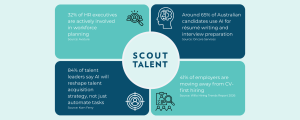
This shift is being driven by adoption on both sides of the hiring equation. Industry data shared by Oncore indicates that around 65% of Australian candidates report using AI for tasks such as résumé writing and interview preparation. At the same time, research suggests that a significant majority of hiring managers now use AI at some stage of the recruitment process, signalling that AI-assisted hiring is rapidly becoming standard practice rather than a future capability.
As AI becomes more deeply embedded in recruitment, the challenge for HR and talent teams is no longer whether to adopt AI, but how to do so effectively. Organisations increasingly need technology where AI is built directly into workflows in a practical, transparent, and governed way, rather than added on as a bolt-on feature. Without this level of integration, hiring decisions risk slowing down, particularly in a tight labour market where speed, consistency, and quality remain critical competitive advantages.
Looking ahead to 2026, organisations that fail to integrate AI effectively into recruitment processes risk falling behind those that remain fast, adaptive, and ahead of the curve. However, adoption is not without its challenges. Research highlighted by CX Focus shows that 44% of HR leaders cite insufficient AI skills among staff as a barrier to effectively using AI-driven recruitment tools, reinforcing the need for both the right technology and the right capability uplift.
Workforce planning will overtake reactive hiring
As labour market conditions remain tight, organisations are increasingly recognising that reactive hiring is no longer sustainable. Waiting for vacancies to arise before acting limits choice, increases time-to-hire, and often forces rushed decisions in an already competitive market. In contrast, strategic workforce planning enables organisations to anticipate demand and act with greater intent.
At its core, effective workforce planning requires translating business strategy into clear, evidence-based workforce requirements. This means identifying the roles, skills, and capabilities needed to deliver future objectives, not just in broad terms, but with enough specificity to guide action. The process starts by understanding where the organisation creates value today and which capabilities will be critical to sustaining that value in the future.
This shift from reactive hiring to deliberate planning was explored in detail at the 2025 Aon Human Capital Insights Conference in Sydney, drawing on insights shared by Chris Hare and Alicia Roach, Co-founders of eQ8, and further outlined in Aon’s analysis on future-proofing skills through strategic workforce planning.
As Alicia Roach explained:
“We need to understand, quantitatively, who needs to have what skills and when in order to meet future objectives. By defining workforce demand in these terms, organisations create a common language between executives and HR leaders. The conversation shifts from broad ideas about capability to clear, time-bound requirements that can be measured and tracked.”
This level of precision is what allows workforce planning to move from theory into practice. Rather than debating whether an organisation has “enough capability,” leaders can assess whether they will need a defined number of people with specific skills, in particular locations, by a given point in time. That clarity enables more realistic assessments of current supply and more targeted decisions about recruitment, development, or redeployment.
Onboarding will be treated as part of recruitment, not an afterthought
The recruitment experience does not end when an offer is accepted. For Australian organisations under pressure to improve retention and hiring quality, onboarding is increasingly recognised as a critical extension of recruitment.
Research from Glassdoor shows a strong connection between candidate experience and quality of hire, with organisations that invest in how candidates are engaged reporting better hiring outcomes overall.
Despite this, many organisations still lack a joined-up approach, with research indicating a significant proportion of employers do not have a clearly defined strategy for engaging candidates early through social and digital recruitment channels.
Further research referenced by Brandon Hall Group reinforces this link, finding that organisations investing in employer branding are significantly more likely to make better hires. Employer branding reflects the strength and credibility of an organisation’s employee value proposition, and onboarding is where that promise is either delivered or broken.
In 2026, organisations that treat onboarding as part of the recruitment journey, rather than a handover to HR, will be better positioned to improve early retention, accelerate time to productivity, and deliver a consistent, credible employment experience from first interaction to first day.
2026 hiring snapshot: what’s changing and what works
Across all seven trends, one message is clear: recruitment in 2026 will be defined by sustained competition, higher candidate expectations, and greater scrutiny on how hiring decisions are made.
What this means for HR teams
- Skills shortages will persist, keeping pressure on speed and attraction
- Pay clarity and early alignment will determine conversion
- Candidate experience will directly influence employer brand and hiring success
- Workforce planning will replace reactive, vacancy-led hiring
- Onboarding will be treated as part of the recruitment journey, not a handover
- Simple, repeatable processes will outperform complex, reactive models
The practical response
Organisations need recruitment models that can scale, attract broadly, and convert efficiently without increasing cost or risk.
Where Scout Talent fits
Scout Talent supports HR teams with both campaign-based recruitment services and recruitment software that make hiring faster, clearer, and easier to manage in a high-pressure market.
Our campaign-based model combines flat-fee pricing, built-in structure, human recruitment expertise, and AI-supported workflows to give teams the clarity, consistency, and flexibility needed to compete confidently in 2026 and beyond.
Beyond the campaign itself, Scout Talent’s software helps organisations stay in control of the full hiring process by providing a central place to manage applications, screening, shortlisting, and decision-making. With features designed to reduce manual admin and improve consistency, the platform supports HR teams to move quickly without sacrificing quality, fairness, or governance.
Whether you need hands-on support to launch a high-performing recruitment campaign or a scalable platform to manage hiring in-house, Scout Talent gives you the tools and support to attract better talent and make better hiring decisions.